


I used to open my analytics, immediately regret it, and close the tab.
Not because the numbers were bad. Because by the time I was logged into everywhere — Fathom, my email platform, my social accounts — I’d forgotten what I was even looking for. I’d end up with twelve open tabs, a mild headache, and zero clarity on what any of it actually meant for my business.
So I built something that fixes that. A personal marketing dashboard that pulls from every platform I’m active on, gives me a plain-English summary of what’s actually happening, and tells me where to focus next. It’s not in a generic “post more consistently” way — in a “here’s what actually moved the needle last week and here’s why it matters” way.
I built it in a couple of afternoons. With no coding experience. Using Claude Code.
Here’s how.
The Real Problem With Marketing Analytics
Most of us already have all the data we need. The problem isn’t access — it’s interpretation. Raw numbers sitting across four different platforms don’t tell you anything useful until someone (or something) connects the dots.
That’s what I wanted this dashboard to do: not just show me the data, but tell me what it means.
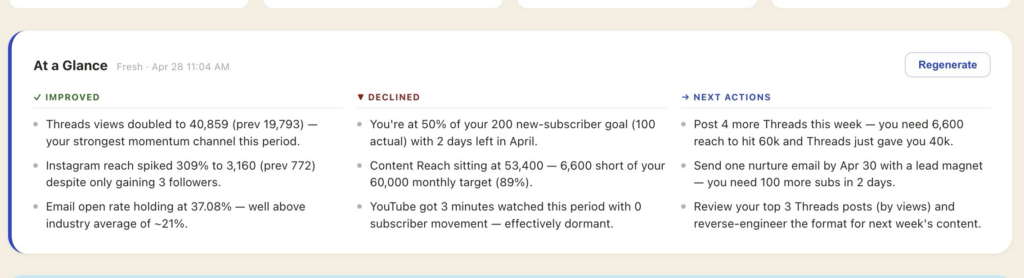
My “At a Glance” section is the part I actually love. It doesn’t just surface metrics — it tells me what improved and why that matters, what declined and whether I should actually be concerned, and gives me 2–3 specific recommendations tied to my real numbers. Not advice that could apply to any business. Mine.
That’s the design principle the whole thing is built around: interpretation is the feature, not the data.
Before You Build Anything, Do This
Here’s where most people waste time (and credits): they open Claude Code and start chatting their way to a dashboard. That’s the wrong move.
Think about it like hiring a contractor. You wouldn’t call a contractor and say “yeah, just like… build me something nice.” You’d come with a brief. Measurements. A vision. Constraints. The more you put in upfront, the less back-and-forth you need later — and with AI tools, back-and-forth costs you.
So before you open Claude Code, do your braindump somewhere else. Paper, Notion, your notes app — anywhere but the Claude conversation. Every message you send uses context. Use that context wisely.
Here’s what your braindump should cover:
What data do you actually want to see? Which platforms matter to your business right now — not the ones you feel guilty about ignoring, the ones you’re actually active on. What metrics do you care about? Not all of them. The ones you would look at and actually make decisions from.
What do you want it to tell you? Do you want interpretation, or just numbers? (You want interpretation. Trust me.) What does a useful “focus next” recommendation look like for your business versus a generic one?
What do you want to leave out? This one’s personal and worth thinking about seriously. If a metric has historically made you spiral, make bad decisions, or feel bad without being useful — leave it out. A good dashboard is designed around the person you want to be, not the one you’re afraid of being. For me, that meant no charts or graphs, no color coding that doesn’t mean anything, no alerts for normal fluctuation.
How will you actually use it? Daily check-in? Weekly? Only when something feels off? That changes the layout, the detail level, the whole thing.
Once you have that clarity, then you open Claude Code and write a real brief.

How Claude Code Actually Builds This
Once you’ve handed Claude Code a solid brief, the process is pretty straightforward:
It builds a first version with placeholder data so you can see the layout and structure before any real numbers are involved. You review it, give feedback on what you want to change, and iterate. When a section is right, you tell Claude explicitly: “this part is done, don’t change it.” Otherwise it might revisit it, even if you didn’t ask.
One habit that saved me multiple times: before asking for any changes, copy your working version somewhere safe. If the next iteration breaks something you liked, you can always roll back without starting over or burning more credits.
The technical part that sounds intimidating but isn’t: API keys. An API key is basically just a password that lets your dashboard talk to another app. You copy and paste it once, and then you never think about it again. That’s it. Once they’re in, your dashboard stops showing placeholder data and starts pulling your actual numbers — from your email platform, your website analytics, wherever you told it to look.
Building the Habit (Because a Dashboard You Never Open Is Just a Fun Project)
Here’s where most people get tripped up. They build something, feel great about it, and then never actually use it.
Let me hold your hand when I say this… The dashboard doesn’t do anything if it lives closed in a tab.
What works: pick one day, one time, put it in your calendar as a recurring 15-minute block. Treat it like a standing meeting with your business — or fold it into your CEO day if you already have one. Same time every week or month. Non-negotiable.
When you open it, ask yourself three questions:
- What actually moved this week?
- Where did I spend energy that didn’t show up in the numbers?
- What’s one thing worth doing differently next week?
That’s it. You’re not doing a deep dive. You’re taking a pulse. You close the dashboard knowing where you stand instead of guessing.
What the Dashboard Doesn’t Do (And Why That’s Important)
The dashboard tells you what’s happening. It doesn’t tell you what to do about it.
If something is working, do more of it — deliberately. Not randomly. Figure out why it worked and build from there.
If something isn’t moving, don’t panic, but don’t ignore it either. Ask whether you’re actually putting time and energy into that platform, and whether it’s even where your people are.
And if you open your dashboard and think “okay, I can see all of this, but I have no idea how to actually move the numbers” — that’s not a data problem. That’s a strategy problem. Seeing your numbers is step one. Building the strategy behind them is step two. A lot of people stop at step one and think they’re done.
Want to Skip the Build?
This took me a couple of afternoons to build from scratch — and honestly, I learned a lot in the process. But if you want to skip straight to having a live dashboard showing your actual numbers, you can buy mine here. Everything is already set up and ready to connect to your accounts.
And if you get there and think — okay, I can see my numbers, but I have no idea how to actually improve them — that’s exactly what Strategies that Stack® is for. It’s my membership where we build the marketing systems and strategy behind these numbers. The dashboard tells you where you stand. Strategies that Stack® is how you change it.